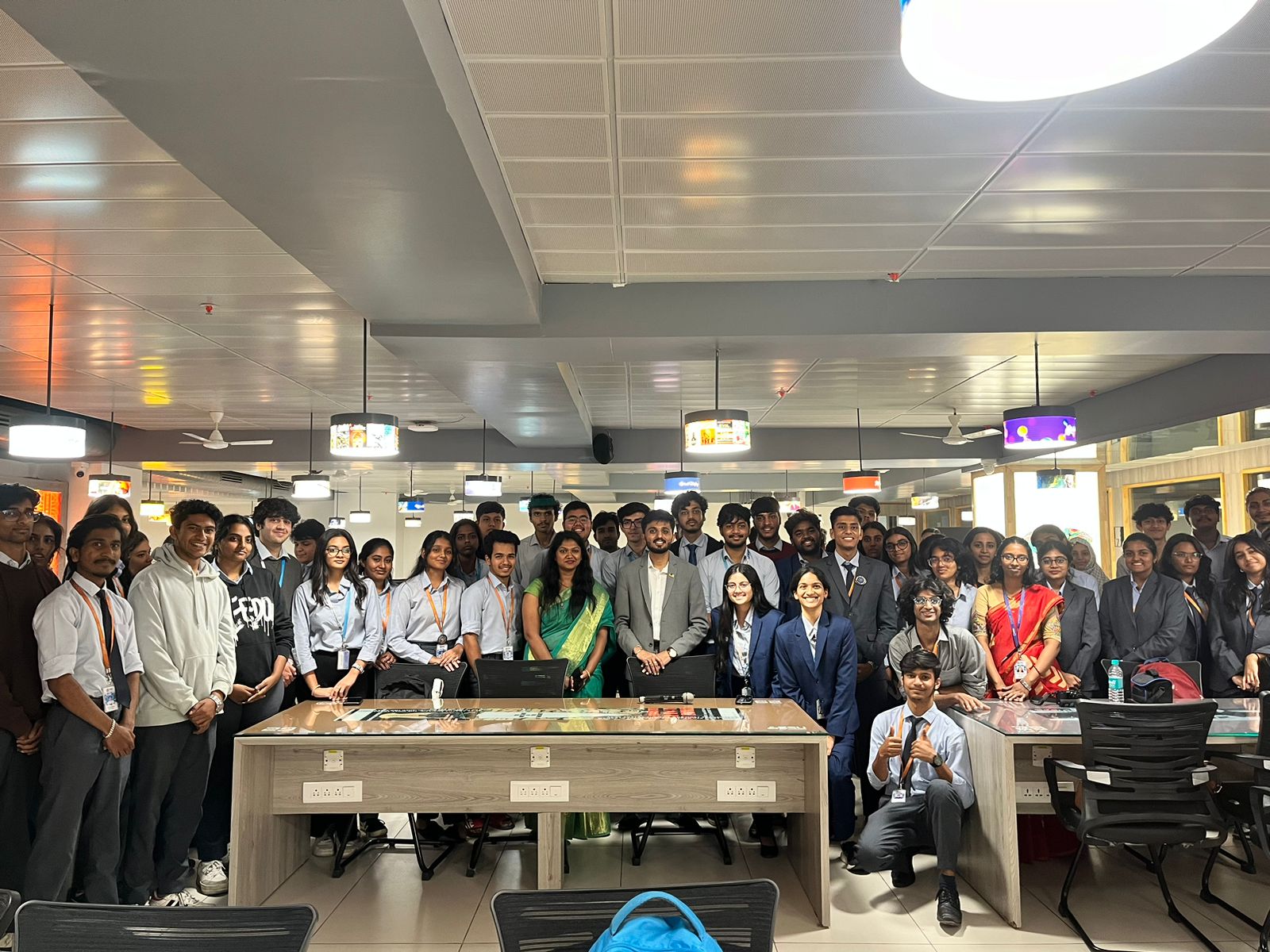



Dove’s Real Beauty campaign: How Dove challenged traditional beauty standards and targeted women of all shapes and sizes.
Dove, a leading personal care brand under Unilever, revolutionized the beauty industry with its Real Beauty Campaign, launched in 2004. The campaign was a bold response to conventional beauty norms and targeted women of all shapes, sizes, and backgrounds, promoting a more inclusive and empowering definition of beauty. By challenging traditional standards and connecting with diverse demographics, Dove has created a powerful movement that has left a lasting impact on both the brand and society at large.
The Birth of the Real Beauty Campaign: A Response to Unrealistic Standards
Dove’s Real Beauty campaign was born from research that highlighted a troubling reality: only 2% of women worldwide considered themselves beautiful. Dove recognized an opportunity to shift the conversation around beauty from unrealistic, airbrushed standards to something more inclusive and authentic.
- Campaign Objective: To challenge the narrow, idealized portrayals of beauty and redefine it in a way that includes all women, irrespective of size, shape, or age.
- Real Impact: Within the first year, Dove’s campaign led to a 700% sales increase in certain markets, demonstrating the power of authenticity and inclusivity.
Targeting Women of All Shapes and Sizes: Demographic Segmentation
Dove’s primary strategy was to break away from traditional beauty marketing, which often showcased young, slim, and conventionally attractive women. Instead, Dove focused on demographic segmentation, targeting women of all ages, shapes, and sizes. This inclusivity enabled Dove to connect with millions of women who felt excluded by the beauty industry.

Detailed Breakdown of Target Audience
- Young Women (18-25 Years Old):
This group often faces immense pressure from social media and the fashion industry to conform to beauty ideals. By targeting younger women, Dove aimed to challenge unrealistic standards and encourage self-acceptance.- Message: Dove promoted self-confidence and individuality, encouraging young women to embrace their natural beauty rather than striving to meet society’s standards.
- Middle-Aged Women (26-45 Years Old):
Women in this age group often experience self-doubt about aging, weight changes, and societal expectations. Dove positioned itself as a champion for body positivity, making middle-aged women feel seen and valued.- Message: Dove emphasized that beauty is timeless and can be celebrated at every stage of life.
- Visual Representation: Dove’s “Real Beauty” ads often featured middle-aged women with visible signs of aging, wrinkles, and natural skin.
- Curvy and Plus-Size Women:
Historically marginalized by the beauty and fashion industries, curvy and plus-size women became a crucial part of Dove’s segmentation. The campaign showcased their beauty, challenging the notion that only slender bodies are beautiful.- Message: Dove promoted the idea that beauty comes in all shapes, sizes, and forms, including those that don’t fit traditional body norms.
- Key Statistic: Following the campaign, 71% of plus-size women reported feeling more represented in the media due to Dove’s inclusivity.
- Older Women (46+ Years Old):
Dove recognized that older women often feel invisible in beauty campaigns. By featuring older women in its ads, Dove reinforced that beauty has no age limit.- Message: Age is beautiful; Dove showed that older women should be celebrated for their wisdom, experience, and natural beauty.
- Women of Various Ethnicities:
Dove deliberately included women from various racial and ethnic backgrounds in its campaign to reflect global diversity.- Message: Dove’s message of natural beauty extended across cultural boundaries, recognizing that beauty is universal.
- Key Statistic: Dove found that 54% of women of color felt more connected to the brand after seeing women from their communities in the campaign.
- Women with Disabilities:
Dove also extended its inclusivity to women with disabilities, featuring them in its ads to challenge the idea that beauty requires physical perfection.- Message: Dove showcased that beauty is more than skin deep, incorporating women with disabilities to represent a broader vision of beauty.
- Visual Representation: Dove ads featuring women in wheelchairs or with visible disabilities to reinforce the notion of inclusive beauty.
Key Message
The message at the heart of Dove’s segmentation strategy was that beauty is for everyone. Instead of using professional models, the campaign showcased real, unretouched women from all walks of life, directly challenging the unrealistic standards promoted by the broader beauty industry.
- Key Statistic: After the campaign, surveys showed that 60% of women said Dove had positively changed their perception of what beauty could look like, feeling more connected to the brand.
By targeting women of all shapes, sizes, ages, ethnicities, and abilities, Dove successfully disrupted the beauty industry. Its Real Beauty campaign remains a landmark in inclusive marketing, offering a blueprint for how brands can meaningfully connect with diverse audiences by championing authenticity and inclusivity.
Expanding the Movement: Global Impact and Future Initiatives
Dove’s Real Beauty campaign has had a lasting global impact, leading to numerous follow-up initiatives and campaigns that continue to promote body positivity and inclusivity. Dove’s partnership with global organizations and schools through the Dove Self-Esteem Project continues to extend the message to younger generations.
- Global Reach: The campaign has been implemented in over 80 countries, making it one of the most influential and recognized beauty campaigns globally.
- Next Steps: Dove has expanded the conversation to include men, transgender individuals, and others who feel underrepresented in the beauty industry. The Real Beauty Pledge, launched in 2017, solidified Dove’s commitment to never use retouching, ensuring that its advertising continues to promote realness.
Tagline: “Beauty Has No Limits – Join the Movement.”
Conclusion
Dove’s Real Beauty campaign is a textbook example of how a brand can effectively use segmentation, targeting, and positioning to connect with a diverse audience. By challenging traditional beauty standards and embracing authenticity, Dove has empowered millions of women worldwide and built a strong emotional connection with its consumers. This campaign not only redefined beauty in the advertising world but also sparked a global movement toward body positivity and self-acceptance.
By incorporating powerful storytelling, relatable imagery, and real-world impact, Dove’s Real Beauty campaign continues to stand out as one of the most successful and transformative marketing efforts of the 21st century.
-

Chapter 2 : Segmentation, Targeting, and Positioning (STP) Segmentation
Nike’s target market segmentation: How Nike tailors its marketing messages to different segments, such as athletes, casual runners, and fashion enthusiasts.

Nike, one of the world’s leading sports brands, has masterfully segmented its market to cater to a wide variety of consumer groups. Through its targeted marketing strategies, Nike addresses the needs and aspirations of professional athletes, casual runners, fashion enthusiasts, and fitness-conscious individuals. This case study delves into how Nike uses segmentation to build strong emotional connections with these diverse audiences and how its tailored marketing efforts resonate within each segment.
1. Professional Athletes
Nike has long been a preferred brand for professional athletes, and its marketing strategy reflects this. By using demographic segmentation to target athletes based on their sports, performance needs, and goals, Nike positions itself as a high-performance brand that delivers cutting-edge technology and innovation.
- Target Audience: Professional athletes in various sports such as basketball, football, track and field, and tennis.
- Marketing Message: Nike highlights the importance of performance and precision. Campaigns often showcase top-tier athletes like LeBron James or Serena Williams, wearing Nike gear designed to maximize their performance.
- Products: High-performance footwear, apparel, and gear specifically designed for competition, with advanced technologies like Nike Air Zoom and Dri-FIT.
Tagline: “Greatness Awaits: Empowering Champions with Innovation.”
2. Casual Runners and Fitness Enthusiasts
Nike uses behavioral segmentation to target casual runners and fitness enthusiasts. This group is not necessarily looking for professional-grade gear but rather products that offer comfort, style, and functionality for everyday fitness activities.
- Target Audience: People who enjoy running, jogging, and maintaining an active lifestyle but may not identify as professional athletes.
- Marketing Message: Nike focuses on the idea of self-improvement and fitness as a journey, often highlighting everyday runners in their campaigns. Nike encourages this audience to set personal fitness goals, emphasizing that Nike gear will support them in every step.
- Products: Running shoes like the Nike Pegasus or Nike Free Run, known for comfort and versatility, and stylish yet functional fitness apparel.
Tagline: “Run Your Own Race: Every Step Counts.”
3. Fashion Enthusiasts
Nike also targets the fashion segment, focusing on individuals who value the brand not just for its sportswear but also as a style statement. The brand uses psychographic segmentation to target fashion-forward consumers who view Nike products as both functional and trendy.
- Target Audience: Sneakerheads, fashion enthusiasts, and people who value athleisure and streetwear culture.
- Marketing Message: Nike emphasizes exclusivity, innovation, and style in this segment. Collaborations with high-end designers (e.g., Off-White, Travis Scott, and Fear of God) and limited-edition sneaker drops help create buzz and excitement.
- Products: Iconic sneakers like the Air Jordans, Air Max, and Nike Dunks, along with premium streetwear collections.
Tagline: “Where Style Meets Sport: Defining Streetwear Culture.”
Visual Example:
4. Youth and Millennials
Nike actively targets millennials and Gen Z consumers who are not only fitness-conscious but also eco-conscious and socially aware. Demographic and psychographic segmentation are used here to engage young consumers who expect brands to be authentic and aligned with their values.
- Target Audience: Millennials and Gen Z, who are into fitness, wellness, and sustainability.
- Marketing Message: Nike’s campaigns often focus on social issues such as diversity, equality, and sustainability. Nike connects with younger audiences by launching initiatives like Move to Zero, its journey towards zero carbon and zero waste.
- Products: Sustainable lines like Nike Space Hippie and Nike Flyleather, along with fitness gear that caters to the active and conscious youth.
Tagline: “Future-Proof Your Run: Sustainability Meets Style.”
5. Women’s Segment
In recent years, Nike has made significant strides in tailoring its products and campaigns to women. Through gender-based segmentation, Nike positions itself as a brand that empowers women to embrace their strength and athleticism.
- Target Audience: Active women who seek stylish, functional, and empowering athletic wear.
- Marketing Message: Nike’s women-focused campaigns often center around empowerment and breaking boundaries. Nike encourages women to be strong and bold, offering products that cater to both performance and lifestyle.
- Products: The Nike Women’s Collection includes sports bras, leggings, and stylish training shoes like the Nike Air Max Dia and Nike React Infinity Run.

Tagline: “Own Your Power: Gear for the Strong and Stylish.”
Conclusion
Nike’s ability to effectively segment its market has enabled it to become more than just a sportswear brand. By tailoring its marketing messages to cater to diverse audiences—from athletes and runners to fashion enthusiasts and millennials—Nike creates deep emotional connections with its customers. Whether it’s through elite sports sponsorships, sustainable product lines, or limited-edition fashion drops, Nike’s segmented approach ensures its continued relevance and dominance in the global market.
-

BMW has established itself as a global leader in the luxury automobile market, producing high-performance, aesthetically refined, and state-of-the-art vehicles. For decades, the German automaker, based in Munich, has been recognized as a brand that represents engineering excellence, sophistication, and comfort. For many, BMW is not just a car manufacturer—it’s a symbol of status and luxury.
The Marketing Mix: A Key to BMW’s Strategy
BMW’s marketing success is not accidental. It’s the result of a well-thought-out marketing mix that targets the premium automobile market. By carefully analyzing the market segmentation and aligning its marketing strategies with customer purchasing behavior, BMW has managed to boost sales and strengthen its market position. Here are key aspects of their marketing mix:
1. Product: BMW focuses on luxury, performance, and cutting-edge technology. Each model is a blend of style and substance, offering a variety of vehicles from electric cars (BMW i series) to sports models (M series) and luxury sedans (7 series).
2. Price: BMW adopts a premium pricing strategy. The higher prices reflect the brand’s promise of superior quality, luxury, and performance, which justifies the cost to their affluent customer base.
3. Place: BMW is a global brand with a presence in over 140 countries. The company’s well-organized dealership networks and partnerships with luxury car retailers ensure that their cars are easily accessible to premium buyers worldwide.
4. Promotion: BMW invests heavily in digital marketing, social media engagement, and innovative advertising to maintain its position as a luxury brand. The company regularly runs creative campaigns showcasing new models and their unique features.
BMW’s Social Media Engagement
Even though BMW is a massive global brand, its approach to social media is similar to other companies. The automaker effectively uses platforms like Instagram, LinkedIn, Facebook, YouTube, and TikTok to showcase new products, engage with its audience, and convey its brand identity.
BMW’s social media strategy hinges on visual storytelling, where high-quality videos and images highlight the car’s features, fostering an emotional bond with its followers.
Additionally, BMW encourages user interaction, frequently responding to comments and promoting user-generated content.
The company invites fans to use the hashtag #BMWRepost, offering them a chance to be featured on its Instagram page, which boasts nearly 35 million followers.
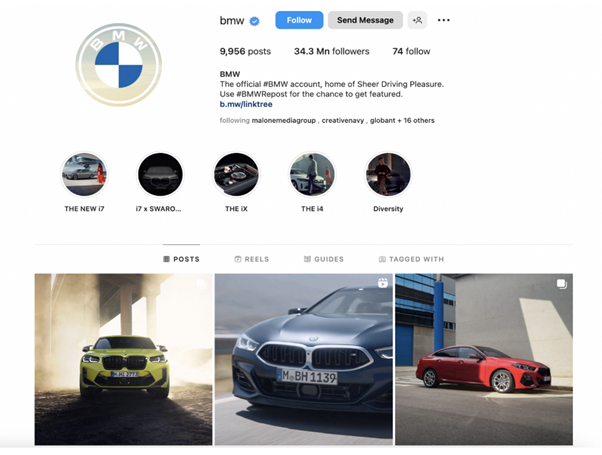
BMW has also explored newer features like Instagram stories and TikTok videos, targeting younger audiences and maintaining relevance in the fast-paced digital space.
Branding Strategy: Maintaining Prestige and Performance
BMW’s brand is synonymous with luxury, performance, and innovation. Their branding focuses on these core values, and their marketing mix strongly reflects this.
- Premium Pricing: BMW’s cars are priced higher than those of most competitors, reinforcing their position as a luxury brand. The high price tag is justified by the superior quality, engineering excellence, and cutting-edge technology integrated into every vehicle.
- Performance-Driven Messaging: BMW’s advertising often emphasizes its cars’ performance capabilities, reflecting the brand’s focus on high-quality engineering. Whether it’s a sports model or a luxury sedan, BMW ensures that performance remains central to the brand’s image.
Here’s the ad for the first-ever BMW M5 CS Sedan, an excellent example of how the company showcases the performance of its German miracle car:
BMW’s Advertising Strategy: A Consistent Message of Innovation and Emotion
- Emotional Connection: BMW’s ads often evoke emotions like freedom, exhilaration, and adventure. The focus is not just on the car but the overall driving experience, helping the audience feel a personal connection to the brand.
Below, find the ad where the brand used its creative storytelling strategies to engage with its audience
- Highlighting Product Features: While BMW taps into emotions, they also create ads that clearly outline key features of their models. This helps customers understand the technical superiority and design elements that set BMW apart from competitors.
BMW iX1 – Electrify Your Dreams
- Consistency Across Platforms: Whether it’s a TV commercial, a social media post, or a digital ad, BMW ensures that their messaging stays consistent. The brand emphasizes luxury, performance, and engineering excellence in every marketing campaign.
Creative Campaigns That Drive Success: Key Outputs of BMW’s Marketing
- Artistic Integration
BMW integrates creativity and artistry into many of its campaigns. For example, in Australia, BMW partnered with the creative agency Clemenger BBDO Melbourne to launch the “Illuminated Landscapes” campaign for the X5 model.
This artistic campaign highlighted the Laser Lights feature of the car by using them to light up artwork displayed on the landscape, showcasing both technological innovation and aesthetic appeal
- Ambassador and Proud Presenter of the Latest Technologies
Considered as one of the biggest tech-savvy brands among their industry, BMW always follows the latest technologies as well as implementing them on the releasing car models. Combining virtual and augmented reality, BMW Art Car #18 has features from VR and AR, and is designed by Chinese artist, Cao Fei.
- Content Marketing as a Flagship Strategy
BMW takes a mobile-first approach to content marketing, focusing on lifestyle, design, and innovation. In 2019, BMW relaunched its website to provide a more user-friendly mobile experience, which resulted in a 27% increase in mobile visitors. Their content goes beyond cars, covering topics like fashion, innovation, and luxury living to engage a broader audience. - Celebrity Collaborations
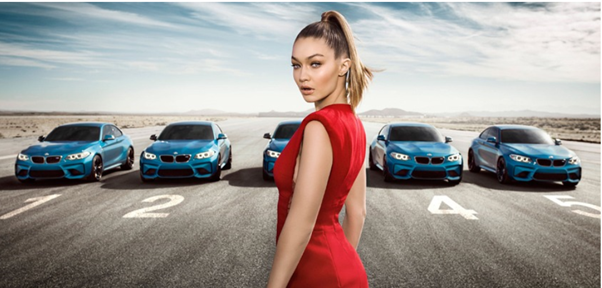
BMW frequently collaborates with high-profile figures to launch new models. For instance, they worked with model Gigi Hadid in the campaign for the BMW M2 Coupe. The interactive 360-degree video, directed by Marc Forster, debuted on platforms like YouTube and Facebook, showcasing BMW’s innovative approach to digital marketing.
- Competitive Edge in Advertising
BMW is known for its clever, sometimes controversial advertising. For example, in a 2019 ad, BMW mocked Tesla’s Model 3 delays, promoting its own 330e plug-in hybrid with the tagline, “Will you wait, or drive?” This playful competitive strategy allows BMW to showcase its readiness while subtly poking at its competitors.BMW: Wait or Drive“You’ll do your taxes twice, maybe more… You’ll ring in the New Year twice, maybe more…” Here, the ad is trying to explain the postponed dates for the Tesla 3 model.“You can pay a deposit and wait, you can put your name on a list, and wait… or you can drive…” We see the Tesla Superchargers in the ad but without the cars on, thus strengthening the BMW’s brand-image. - Innovative Social Media AdsBMW was the first brand to launch Snapchat’s augmented reality (AR) ads, allowing users to interact with a 3D model of the BMW X2. This forward-thinking approach helped the brand connect with younger, tech-savvy customers in a novel way, offering an immersive and interactive experience.
Conclusion: BMW’s Bold and Futuristic Marketing
BMW’s digital marketing strategy combines luxury, creativity, and cutting-edge technology to maintain its position as a global leader in the automotive industry. Whether through innovative campaigns, emotional advertising, or strong social media engagement, BMW continually pushes the boundaries of marketing, creating a deep connection with its audience. Their successful approach offers valuable lessons in branding, performance messaging, and digital engagement for any company seeking to elevate its own marketing game.
-
ResourcesShreeram2022-08-15T15:51:43+00:00